Requirement management: the unit of work that actually gets done
The requirement is where compliance stops being a clause and becomes real work, owned by a named person, backed by proof, and never closed on a promise. You always know what is actually done and what still is not.
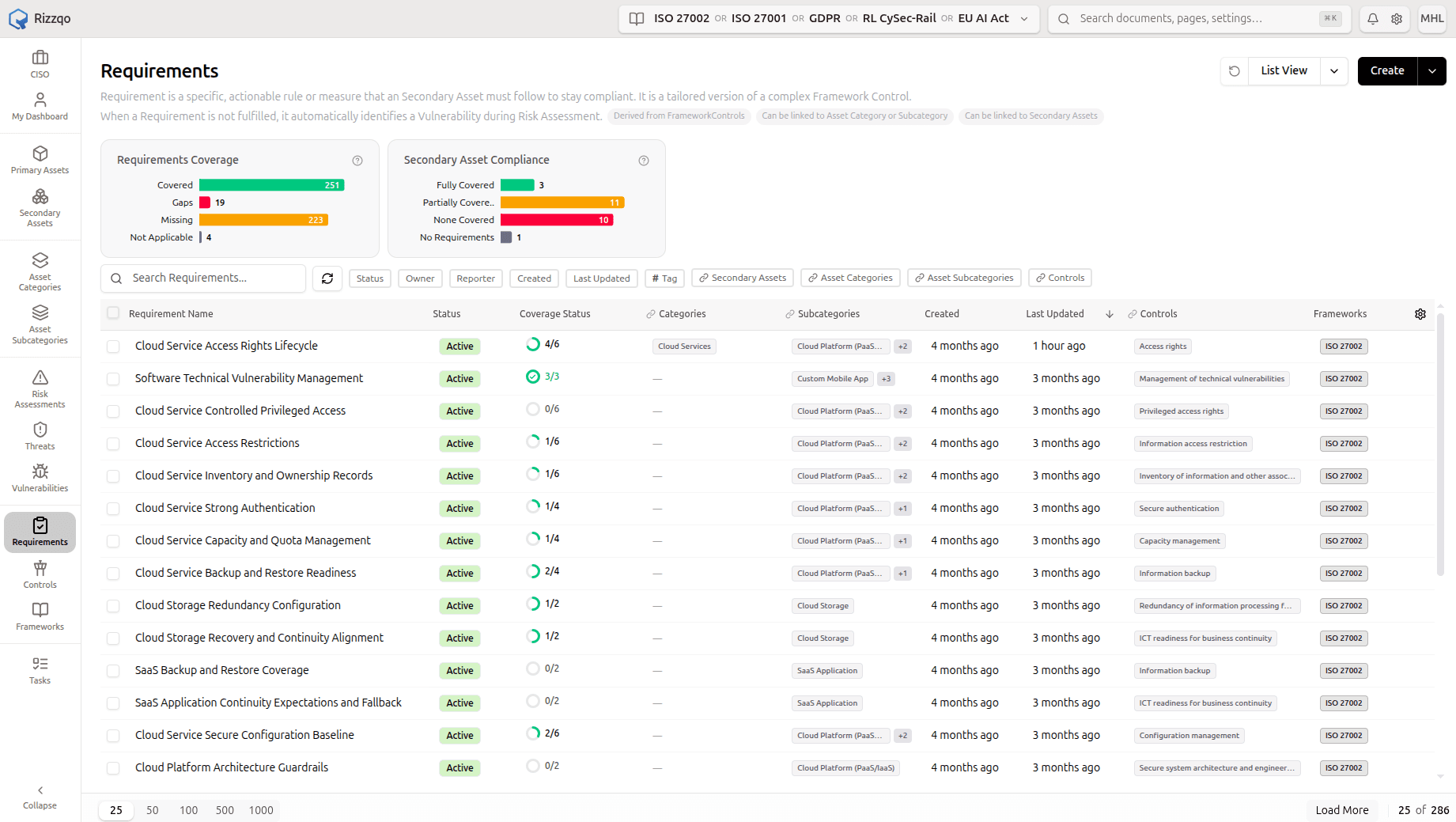
Every requirement is a complete piece of work
A requirement is not a checkbox. It is one provable piece of compliance, owned by a real person, backed by evidence, and marked done only when the work actually is.
A specific instruction
Plain-language guidance a person can act on, not a clause to interpret.
A named owner
One accountable person, never a shared inbox or a team alias.
Evidence at the source
Real proof attached to the requirement, ready before an auditor asks.
A fulfilment status
Fulfilled or unfulfilled, tracked live and never assumed.
A link to the control
Every requirement traces back to the control and framework it satisfies.
One control becomes work people can actually do
A single control rarely means the same thing twice. The work to meet it on a cloud service is not the work in a server room. Rizzqo turns each control into the specific work each kind of system actually needs, so people get an instruction they can act on, not a standard they have to interpret.
Control
The obligation your framework requires.
Your systems
The kind of system the work applies to.
Requirement
The specific, owned work that gets it done.
Every requirement lands on a named owner
No requirement floats unassigned. Each one sits with a single accountable owner who sees exactly what to do and by when, and is nudged while there is still time, so gaps surface as they arise instead of waiting for an audit to expose them.
One accountable owner
Every requirement sits with a single named person, never a shared inbox or a team alias.
A clear due date
The owner sees exactly what to do and by when, so nothing drifts along without a deadline.
Nudged in time
A reminder lands while there is still time to act, so gaps surface as they arise, not at the audit.
Evidence captured at the source
The evidence is created where the work happens, so the audit is just a read of what is already true.
Fulfilled or unfulfilled, always clear
Every requirement carries one honest status, so you can see at a glance what is done, what is still open, and who owns the gap. Readiness becomes a live number you watch all year, not a figure you assemble the week before an audit.
Everything a requirement needs to be real
Rizzqo gives each requirement the structure, ownership and proof that turn a standard into completed, defensible work.
Work tailored to each system
Each control becomes the specific work each kind of system actually needs.
Clear ownership
Every requirement sits with one accountable owner.
Evidence at the source
Proof captured as the work happens, ready before the audit.
Live status
Fulfilled or unfulfilled, tracked live across your program.
Gaps surface early
Owners are alerted to open requirements, so nothing waits for an audit to appear.
Gaps become priced risk
An open requirement automatically becomes risk with a real-money figure attached.
An unmet requirement is a gap with a price
A requirement left unfulfilled does not just sit on a list. Rizzqo puts a real-money figure on the gap and carries it into risk, so leadership can see exposure fall and fund the fixes that matter most. Prove the work once, and it clears in compliance and risk at the same time.
Frequently asked questions
A requirement is the specific piece of work that satisfies a control on the ground, with its own owner and its own evidence. The control comes from your framework in Compliance Management; the requirement is where that obligation becomes work someone can actually do and prove.
Because meeting a control on a cloud service is not the same as meeting it in a server room. Rizzqo turns each control into the specific work each kind of system needs, so owners get an instruction they can act on rather than a clause they have to interpret.
Every requirement sits with one accountable owner, never a shared inbox. The owner sees exactly what to do and by when, and is nudged while there is still time. Accountability is specific, not spread across a team.
It means proof is attached as the work is done, not gathered in a scramble before an audit. The same evidence that closes the requirement is what the auditor reviews, so nothing has to be reconstructed.
Every requirement carries a live fulfilled-or-not status. You can see at a glance what is done, what is open, and who owns each gap, so readiness is a number you watch all year, not one you assemble in audit week.
An unmet requirement automatically becomes risk, scored, priced and routed to a fix. Because compliance and risk share the same requirements, proving the work closes the gap in both places at once.
Turn every control into work that gets proven
See how Rizzqo turns each control into specific, owned work, captures the evidence as it happens, and puts a real-money price on every gap that is left.