


At a glance
- Purpose
- Security requirements for running, servicing and building industrial control systems
- How it works
- Zones and conduits, seven foundational requirements, security levels SL 1 to SL 4
- Governing standard
- The IEC 62443 series; it is a standard, not a law
- Who is responsible
- Asset owner, service provider and product supplier, each for their own parts
- Certification
- Per part and scope, through IECEE, ISASecure or a certification body's own scheme
- Not to be confused with
- ISO/IEC 27001 (an organization's ISMS); OT security (the wider discipline)
Who needs IEC 62443?
The IEC 62443 standard is for plant operators, integrators and makers of controllers, gateways and industrial software. A contract or a tender can make it binding. OT security covers the wider discipline, including threats and the NIS2 scope.
Section 30(2) of the BSI Act (BSIG) does not name the series. It says measures should take relevant European and international standards into account. The duty falls on particularly important entities (besonders wichtige Einrichtungen; "essential entities" in the NIS2 Directive) and important entities. Section 28(5) and (6) BSIG exempts some, such as DORA financial entities.
Which part of IEC 62443 applies to you?
Your role decides the part. The IEC sorts the series into four clusters: common foundations, policies and procedures, system requirements and component requirements. This table shows the parts each role starts with, as of November 2026.
| Part | For | What it sets | Current edition |
|---|---|---|---|
| TS 62443-1-1 | Everyone | Terms, concepts, models, the seven foundational requirements | 1.0, 2009 |
| 62443-2-1 | Asset owners | Security program for systems in operation | 2.0, 2024 |
| 62443-2-4 | Service providers | Security processes for integration and maintenance | 2.0, 2023 |
| 62443-3-2 | Asset owners, integrators | Risk assessment, zones and conduits, target levels | 1.0, 2020 |
| 62443-3-3 | Integrators, system suppliers | System requirements and capability levels | 1.0, 2013 |
| 62443-4-1 | Product suppliers | Secure development lifecycle | 1.0, 2018 |
| 62443-4-2 | Product suppliers | Technical requirements for components | 1.0, 2019 |
IEC 62443-3-3 and IEC 62443-4-2 hold the technical requirements, built on the same seven foundational requirements. Part 3-3 applies them to a whole system and part 4-2 to one component. Part 4-1 covers how a supplier develops products.
How do IEC 62443 security levels work? A filled example
IEC 62443 security levels run from SL 1 to SL 4 and tie countermeasures to the strength of an attacker. SL 1 protects against casual or coincidental violation. SL 4 protects against sophisticated means with extended resources, IACS-specific skills and high motivation. For a zone or conduit, the level is a vector of seven values, one per foundational requirement. So "SL 2" alone does not tell you whether a controller fits your zone.
The part 3-2 risk assessment gives the target level (SL-T) of each zone. Parts 3-3 and 4-2 define the capability level (SL-C) of a system or component. Compare them value by value.
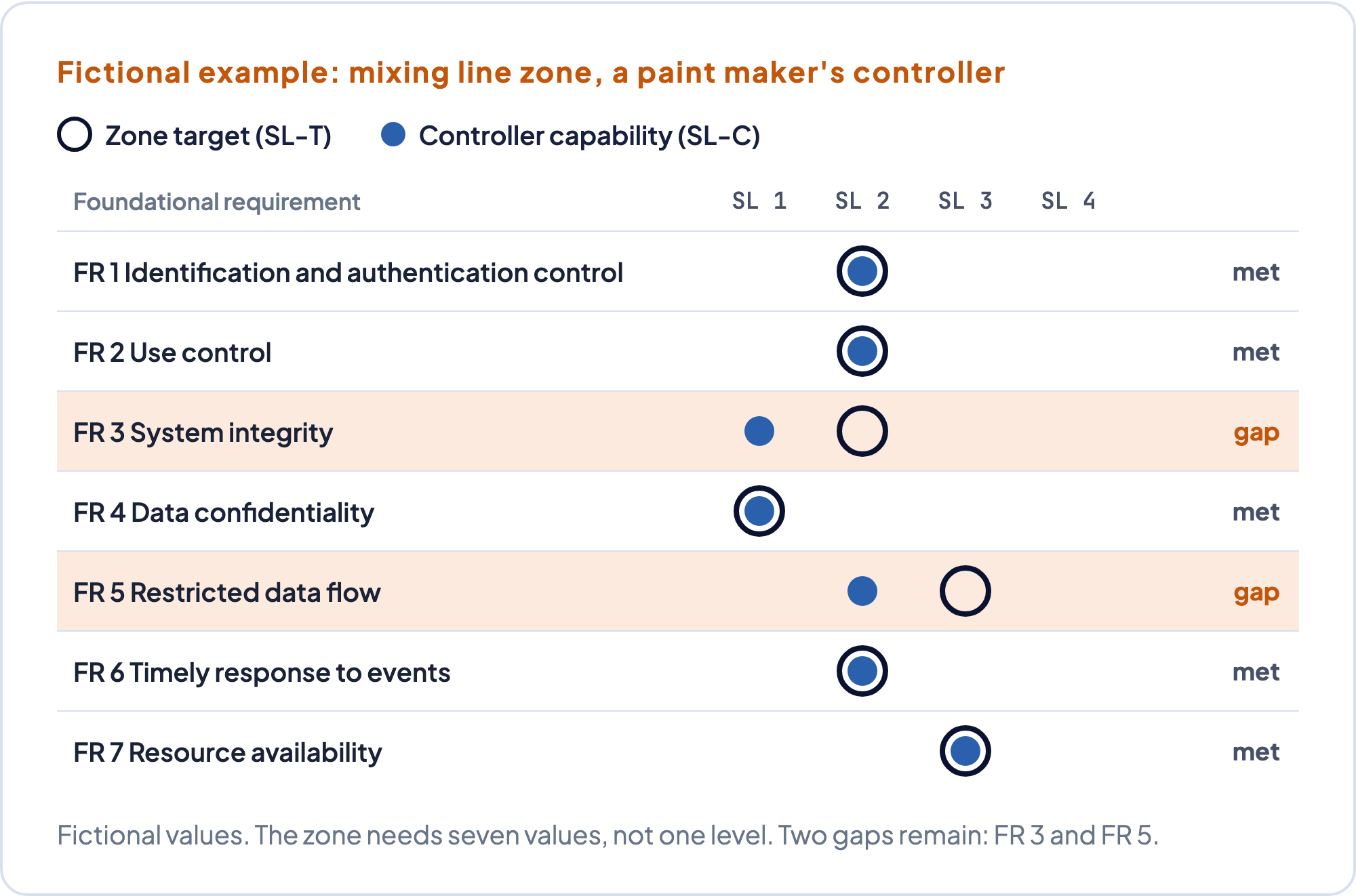
Fictional example: a paint maker checks a controller for its mixing line. The figures are invented for illustration.
| Foundational requirement | SL-T of the zone | SL-C of the controller | Result |
|---|---|---|---|
| FR 1 Identification and authentication control | 2 | 2 | met |
| FR 2 Use control | 2 | 2 | met |
| FR 3 System integrity | 2 | 1 | gap |
| FR 4 Data confidentiality | 1 | 1 | met |
| FR 5 Restricted data flow | 3 | 2 | gap |
| FR 6 Timely response to events | 2 | 2 | met |
| FR 7 Resource availability | 3 | 3 | met |
Use the same five steps on your own zone:
- Run the part 3-2 risk assessment and write down seven SL-T values per zone.
- Ask the supplier for the SL-C per requirement, from the certificate or the product documentation.
- Compare the values. An SL-C equal to or above the SL-T passes. Here, FR 3 and FR 5 fail.
- Decide each gap. For FR 5, a firewall on the conduit can act as a compensating countermeasure. For FR 3, pick a controller that reaches SL 2 or document another countermeasure.
- Check the achieved level (SL-A) in operation, and repeat the comparison when the zone changes.
This check needs a record of which controller sits in which zone, so keep it in your asset inventory.
How do you get IEC 62443 certification?
IEC 62443 certification covers a named part and scope, such as a program, a process, a component or a system. Pick the row that matches what your customer or auditor asks for.
| What is certified | Part | ISASecure program |
|---|---|---|
| Operating automation site, including its service providers | 2-1, 2-4, 3-2, 3-3 | ACSSA |
| Product development process | 4-1 | SDLA |
| Component | 4-2 | CSA, ICSA |
| System | 3-3 | SSA |
Three routes exist. IECEE runs an Industrial Cyber Security Capability Scheme within its CB framework. ISASecure has its programs assessed by ISO/IEC 17065 accredited bodies. Other certification bodies run private schemes with their own method. According to ISASecure, its scheme evaluates all applicable requirements for a target level, while IECEE can let a customer exclude some. So read the scope and the level on any certificate. IECEE certificates can be checked in the IECEE database.
TÜV Rheinland and TÜV NORD describe these steps:
- Choose the part and the scope.
- Close the gaps. TÜV Rheinland starts with a gap analysis.
- Go through the assessment. TÜV NORD audits a program for readiness, then for certification. TÜV Rheinland evaluates a product technically and reviews its security tests.
- Receive the certification decision and the certificate.
At ISASecure, a component certificate also depends on the development process. CSA requires a 4-1 process assessment, which can run in parallel. A site or program certificate runs for three years at ISASecure ACSSA and TÜV NORD. TÜV NORD adds yearly surveillance audits.
IEC 62443 vs ISO 27001: what does each one cover?
ISO/IEC 27001 is the standard for an organization's ISMS. IEC 62443 also reaches the plant, the system and the product.
| ISO/IEC 27001 | IEC 62443 | |
|---|---|---|
| Covers | Information security management of an organization | Industrial control systems in operation, service and development |
| Certificate names | The ISMS and its scope | A program, process, system or component |
| Grading | Requirements met or not | Security levels per requirement; four maturity levels in part 4-1 |
The question decides which one you show. If a customer asks how your company runs information security, that is ISO/IEC 27001. If a customer asks whether your controller fits their zone, that is IEC 62443-4-2. A plant operator can run both, with the ISMS as the frame for the whole organization.
Does an IEC 62443 certificate meet the CRA?
An IEC 62443 certificate does not by itself give the presumption of conformity under the Cyber Resilience Act. Article 27(1) of Regulation (EU) 2024/2847 ties that presumption to harmonized standards cited in the Official Journal. The CRA's product requirements apply from December 11, 2027.
The DKE status list (October 2026) covers the EN 50770 security profiles for products such as VPNs and firewalls. It lists them as projects for vertical harmonized standards, based on EN IEC 62443. Amendments to parts 3-3, 4-1 and 4-2 appear as supporting standards.
If you make connected products, align development with parts 4-1 and 4-2 now. Check the Official Journal before you claim the presumption. The other duties are on the Cyber Resilience Act entry.
In Rizzqo
IEC 62443 in Rizzqo: line, systems, evidence
IEC 62443 is supported in Rizzqo. You record a production process such as the mixing line and rate its confidentiality, integrity and availability. In asset management, you link it to the controllers, the production network and the service obtained from your maintenance provider. Requirements from frameworks such as ISO 27001 or the CRA attach to each relevant system. The right person implements them and uploads evidence, such as a supplier's 4-2 certificate. Each controller then shows which of its requirements are met or still open. A requirement linked to controls of ISO 27001 and the CRA takes one answer, and its evidence counts for both.