


At a glance
- Purpose
- Manage environmental impact and compliance obligations in a certifiable system
- How it works
- Find aspects and obligations, set objectives, control processes, check results, improve
- Governing standard
- ISO 14001:2026; in Germany DIN EN ISO 14001:2026-06
- Who is responsible
- Top management answers for the system's effectiveness (clause 5.1)
- Who certifies
- Accredited certification bodies; DAkkS accredits them in Germany
- Not to be confused with
- EMAS, the EU scheme with a public environmental statement
Who needs ISO 14001?
The ISO 14001 standard fits organizations of any type and size, and applying it is voluntary. You need a certificate when a customer or a public tender asks for one. ISO says a company can apply the standard without getting certified.
The meaning of ISO 14001 comes down to three points. You know which activities affect the environment. You control the ones that matter. You can show that the controls work.
Clause 1 of the standard states no specific environmental performance criteria, so it names no emission limits. You set your own objectives. Your permits and the law set the limits.
What does an ISO 14001 environmental management system require?
An ISO 14001 environmental management system is the management system that runs clauses 4 to 10 of the standard. An environmental aspect is the way an activity, product or service interacts or can interact with the environment. A compliance obligation is a law, a permit condition or a commitment you chose to accept. A legal register is one way to keep these obligations in one list.
| Clause | Topic | What you do |
|---|---|---|
| 4 | Context | Set the scope and name the environmental conditions that affect you |
| 5 | Leadership | Top management answers for the system and sets the environmental policy |
| 6 | Planning | Find aspects and obligations, rate risks and opportunities, set objectives, plan changes |
| 7 | Support | Provide resources, competence and awareness; communicate; keep documented information |
| 8 | Operation | Control processes, including external ones, and prepare for emergencies |
| 9 | Performance evaluation | Measure results, check compliance, run the internal audit and the management review |
| 10 | Improvement | Correct each nonconformity and improve continually |
Which environmental aspects are significant? A filled-in example
Clause 6.1.2 asks you to find your aspects and pick the significant ones by set criteria. The standard prescribes no method. The one below is our own example.
Fictional example, all figures invented: a metal parts maker rates its paint shop and office.
The rule: score = severity (1 to 3) × frequency (1 to 3). An aspect is significant at 6 or more, or when a binding obligation applies.
| Aspect | Condition | Severity × frequency | Obligation | Result |
|---|---|---|---|---|
| Solvent emissions from the spray booth | Normal | 3 × 3 = 9 | Limit in the operating permit | Significant |
| Solvent spill in the storage area | Emergency | 3 × 1 = 3 | Permit condition on storage | Significant, through the obligation |
| Office paper use | Normal | 1 × 3 = 3 | None | Not significant |
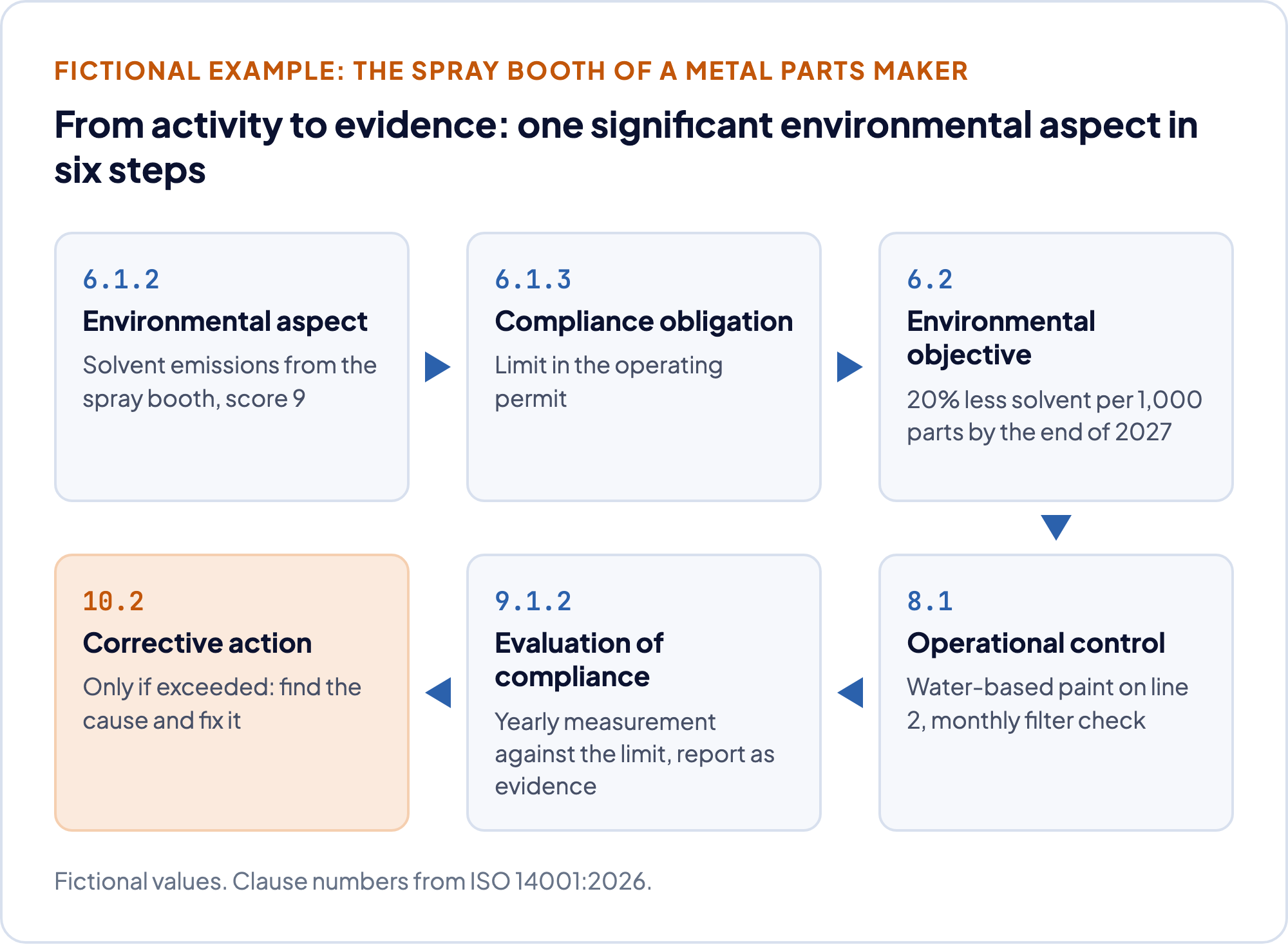
The office paper line gets no objective. The budget goes to the spray booth: water-based paint on line 2 and a monthly filter check. The objective is 20% less solvent per 1,000 parts by the end of 2027. The spill gets an absorbent kit and a yearly drill under clause 8.2. A yearly measurement checks the permit limit under clause 9.1.2, and its report is the evidence. If it exceeds the limit, clause 10.2 calls for a corrective action: find the cause and fix it.
How does ISO 14001 certification work?
ISO 14001 certification is an audit by an independent certification body. ISO itself does not certify anyone. Six steps lead there:
- Run a gap analysis against the standard and list what is missing.
- Build the missing parts and put them to use.
- Complete an internal audit and a management review.
- Choose a body accredited for ISO 14001.
- Pass the stage 1 audit, which checks scope, documents and readiness.
- Pass the stage 2 audit, which checks use and effectiveness through interviews, records and site visits.
The certificate runs for three years. A surveillance audit takes place each year, and a recertification audit comes before expiry.
What changed in ISO 14001:2026?
ISO 14001:2026 replaced ISO 14001:2015 and keeps the clause structure of 4 to 10. As of November 2026, two accreditation sources give the same dates: Global ACI worldwide and DAkkS for Germany.
| Date | What applies |
|---|---|
| From 31 October 2027 | New and initial accredited certificates only to ISO 14001:2026 |
| By 30 April 2029 | Holders of ISO 14001:2015 certificates complete the move, new certificate included. After that, certificates to the 2015 edition are no longer valid |
The move can happen in a surveillance audit, a recertification audit or a separate transition audit. Check these points, close the gaps and agree on the audit date with your certification body:
- Clause 4.1: environmental conditions such as climate change and biodiversity are part of your context.
- Clause 6.1.4: risks and opportunities have their own clause.
- Clause 6.3: planning of changes is new.
- Clause 8.1: you define the control or influence over externally provided processes, products and services.
- Clause 9.2.2: the internal audit program sets audit objectives.
- Clause 9.3: the management review now splits into general, inputs and results.
ISO 14001 or EMAS: which one do you need?
EMAS is a voluntary EU scheme under Regulation (EC) No 1221/2009. According to the German Environment Agency, EMAS organizations meet all ISO 14001 requirements and go beyond them.
| Point | ISO 14001 | EMAS |
|---|---|---|
| Legal form | International standard | EU regulation |
| Who checks | Accredited certification body | Environmental verifier |
| Public record | No public environmental statement required | Validated environmental statement; public EMAS register |
| Cycle | Certificate for three years, yearly surveillance | Full verification at least every three years, yearly validated update (Article 6); longer for small organizations on request (Article 7) |
The choice has a legal effect in Germany. Section 8 of the Energy Efficiency Act (EnEfG) applies to companies whose average yearly final energy use over the last three completed calendar years exceeds 7.5 GWh. Such a company needs an energy or environmental management system. Section 3 EnEfG defines these as DIN EN ISO 50001 and EMAS, so ISO 14001 alone does not count today. A government bill would raise the threshold to 23.6 GWh and accept a system certified to ISO 14001. It names the 2015 edition. As of November 2026, it is in committee and not law.
In Rizzqo
ISO 14001 in Rizzqo: process, systems, evidence
ISO 14001 is supported in Rizzqo. You record a process such as the paint shop. In asset management, you link it to what it depends on. Examples are the exhaust air system and the service obtained from the waste disposal firm. Requirements attach to each relevant system. The right person implements them and uploads evidence, such as the yearly measurement report. The exhaust air system then shows which of its requirements are met or still open.