


At a glance
- Purpose
- Build, run and improve a management system for personal data
- How it works
- Clauses 4 to 10 set the system; Annex A lists controls by role
- Governing standard
- ISO/IEC 27701:2025, second edition; in Germany DIN EN ISO/IEC 27701:2026-02 (status: November 2026)
- Who certifies
- An accredited certification body; certification is voluntary
- Certificate
- Three-year cycle with a surveillance audit each year
- Not to be confused with
- A certification under Article 42 GDPR; ISO 27001
Who needs ISO 27701?
ISO 27701 fits any organization that decides how personal data is used, or that handles it for someone else. It works as a management system for privacy. You set the scope, assess privacy risks, apply controls and show that the system works. According to ISO, it applies to all types and sizes of organization, public and private.
ISO 27701 is a voluntary standard, not a law. In the EU, the binding rules sit in the GDPR. Article 5(2) GDPR says a controller must be able to demonstrate compliance. A PIMS produces records you can use for that.
Processors have a second reason. Under Article 28(1) GDPR, a controller may only use processors that offer "sufficient guarantees". A customer can read your certificate as one piece of evidence in that check.
How is ISO 27701:2025 built?
ISO 27701:2025 has a management system part and a control part. Its term is PII (personally identifiable information). In GDPR terms, read personal data.
| Part | What it holds |
|---|---|
| Clauses 4 to 10 | The management system: context, leadership, planning, support, operation, performance evaluation and improvement |
| Annex A | The controls: Table A.1 for PII controllers, Table A.2 for PII processors, Table A.3 for both |
| Annex B | Guidance on implementing each control |
| Annexes C, D and E | Mappings to ISO/IEC 29100, the GDPR, ISO/IEC 27018 and ISO/IEC 29151 |
| Annex F | How the 2019 edition corresponds to the 2025 edition |
Which controls apply to you? A role check
Your role in each processing activity decides which Annex A tables you use. Run this check on your own list:
- List your processing activities. If you keep records under Article 30 GDPR, start there.
- Ask who decides the purposes and means of each one. If you decide, you are the controller (Article 4(7) GDPR). If you act for someone else, you are the processor (Article 4(8) GDPR).
- Mark the tables. A controller uses Tables A.1 and A.3. A processor uses Tables A.2 and A.3.
- Record your choice in the Statement of Applicability. Give a reason for each control you exclude.
Fictional example: a firm sells HR software as a service.
| Processing activity | Who decides | Role | Annex A tables |
|---|---|---|---|
| Payroll for its own staff | The firm | Controller | A.1, A.3 |
| Newsletter to prospects | The firm | Controller | A.1, A.3 |
| Hosting customers' employee records | The customer | Processor | A.2, A.3 |
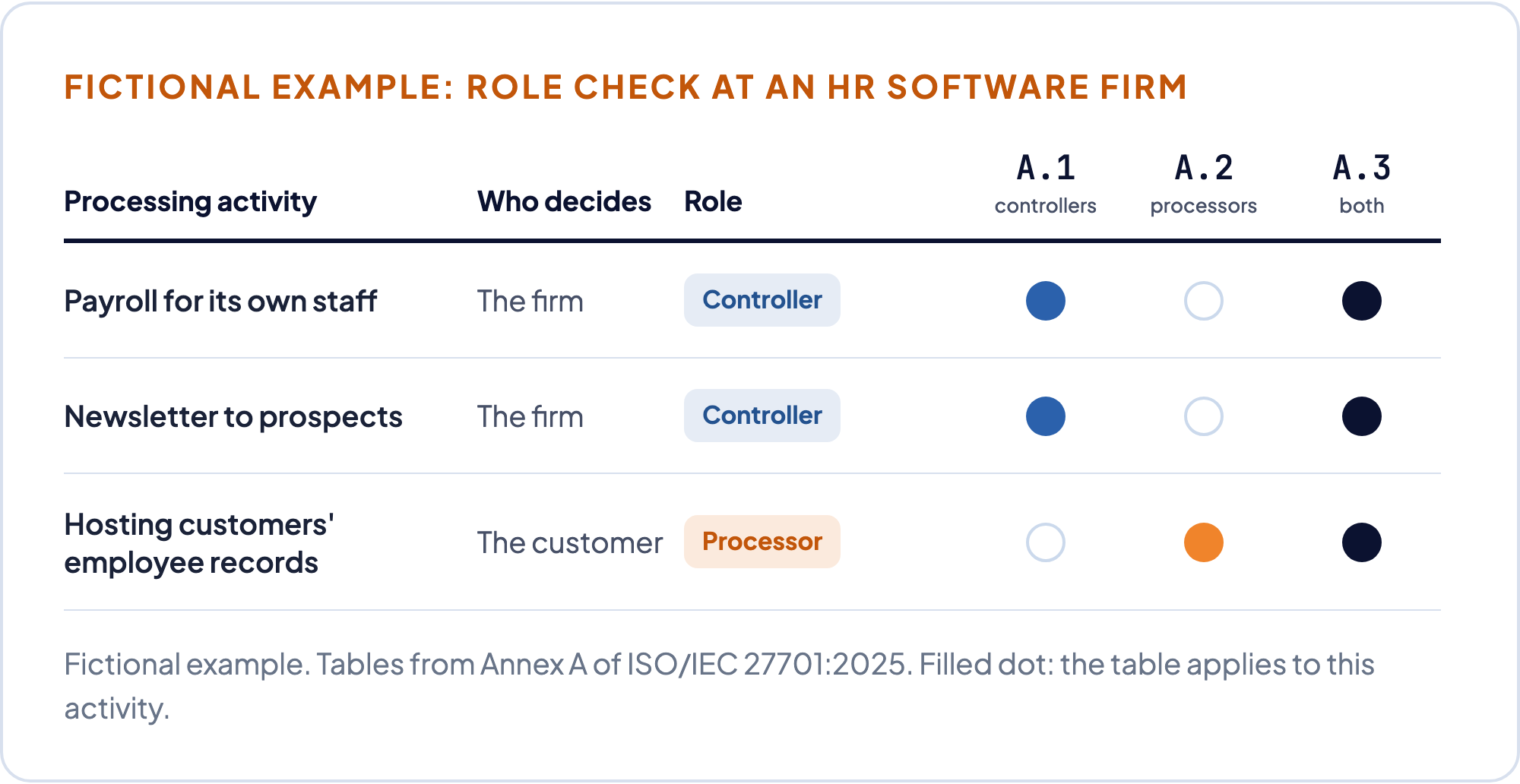
Set the scope first, because it changes the result. With all three activities in scope, the firm works from all three tables. If the PIMS covers only the hosted service, it works from Tables A.2 and A.3. It then states in the Statement of Applicability why it excludes Table A.1.
How do you implement ISO 27701 and get certified?
ISO 27701 certification is an audit by an accredited certification body. The route has five steps:
- Gap analysis: compare your privacy processes with the standard.
- Build the PIMS: scope, roles, processing activities and measures.
- Internal audit: find and close what is still open.
- Stage 1 audit: the auditor reviews your documents.
- Stage 2 audit: the auditor checks that the system works in daily use, through interviews and samples.
The certification cycle runs three years, with a surveillance audit each year. A recertification audit before expiry starts the next cycle.
ISO 27701 and the GDPR: does the certificate prove compliance?
No. An ISO 27701 certificate is not a certification under Article 42 GDPR. Article 42(5) calls for criteria approved by a supervisory authority or the European Data Protection Board. ISO 27701 is not on the Board's register of these mechanisms (checked November 2026).
This matters for fines. Article 83(2)(j) GDPR lets authorities weigh adherence to approved mechanisms, and your ISO certificate is not one. The French regulator CNIL wrote of the 2019 edition that it is not a GDPR certification instrument. It also said a PIMS helps with accountability.
Annex D maps the standard to GDPR articles. Use it to plan your gap analysis. You still assess your own legal duties, such as your lawful basis for each activity.
ISO 27701 vs 27001: which do you need?
ISO 27701 covers personal data, and ISO 27001 covers the security of all your information.
| Question | ISO 27001 | ISO 27701:2025 |
|---|---|---|
| Management system | ISMS | PIMS |
| What it protects | Confidentiality, integrity and availability of information | Personal data, by your role as controller or processor |
| Certified on its own | Yes | Yes, since the 2025 edition |
If customers only ask for privacy proof, ISO 27701 alone can be enough. If they also ask for security proof, take both. The clause structure matches, so one combined audit can cover the two.
ISO 27701 transition: what if you hold a 2019 certificate?
A certificate to ISO/IEC 27701:2019 has to move to the 2025 edition. ISO has withdrawn the 2019 edition, which was an extension of ISO 27001 and ISO 27002. The British accreditation body UKAS sets these dates (status: November 2026):
| Date | Step |
|---|---|
| 14 October 2025 | ISO/IEC 27701:2025 published |
| 31 October 2027 | UKAS has moved the certification bodies it accredits |
| 31 October 2028 | Those bodies have moved all their certified clients |
Other accreditation bodies publish their own timetables, so ask your certification body which one applies. Start your gap analysis with Annex F. Then rebuild your Statement of Applicability around the new Annex A.
In Rizzqo
ISO 27701 in Rizzqo: personal data on your assets
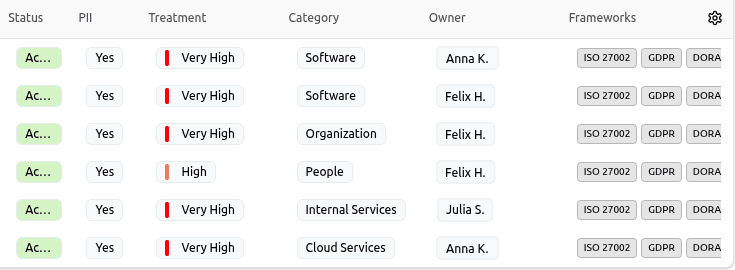
ISO 27701 is supported in Rizzqo. You record a process that handles personal data, such as customer support, and rate its confidentiality, integrity and availability. You also set its personal-data flag. In asset management, you link the process to the systems it depends on, such as the help desk software. Those systems inherit the confidentiality rating and the personal-data flag. Requirements attach to each relevant system, and the right person implements them and uploads evidence, such as a processor agreement. The help desk software then shows which of its requirements are met or still open. If you also run ISO 27001, link one requirement to controls in both, so a single answer and its evidence serve both.