


At a glance
- Purpose
- Assess, prioritize and communicate cybersecurity risks
- How it works
- The Core sets outcomes, Profiles record your status and target, Tiers are optional
- Governing document
- NIST CSWP 29, version 2.0 of February 26, 2024 (current as of November 2026)
- Legal status
- Not a law; most organizations use it voluntarily
- Who is responsible
- Organizational leadership answers for cybersecurity risk (GV.RR-01)
- Not to be confused with
- ISO/IEC 27001, a certifiable ISMS standard; NIST SP 800-53, a control catalog
Who needs NIST CSF, and what does NIST CSF compliance mean?
NIST CSF lists what sound cyber risk management should achieve and leaves the method to you. It fits any size and sector, and no single country.
According to NIST, most organizations use it voluntarily. It names one mandate: Executive Order 13800 made it binding for US federal agencies. Some companies also require it from customers or suppliers.
NIST offers no formal test of NIST CSF compliance and no certification. It plans no conformity assessment program. What you can show a partner is a Current Profile.
In Germany, the legal duty sits in Section 30 of the BSI Act (BSIG), which implements NIS2. Particularly important entities (besonders wichtige Einrichtungen; "essential entities" in the NIS2 Directive) and important entities must take risk management measures. They must also document that they comply. Section 28(5) and (6) BSIG exempts some entities, among them DORA financial entities.
ENISA's mapping table links Implementing Regulation (EU) 2024/2690 to CSF 2.0 point by point. That regulation covers cloud, data center and managed service providers, among others.
ENISA says the table is no measure of equivalence. It does not assess whether a framework fully covers the regulation. You may build on a CSF Profile you already have. Check each duty against the regulation, or against the ten areas in Section 30(2) BSIG.
How does the NIST CSF framework work?
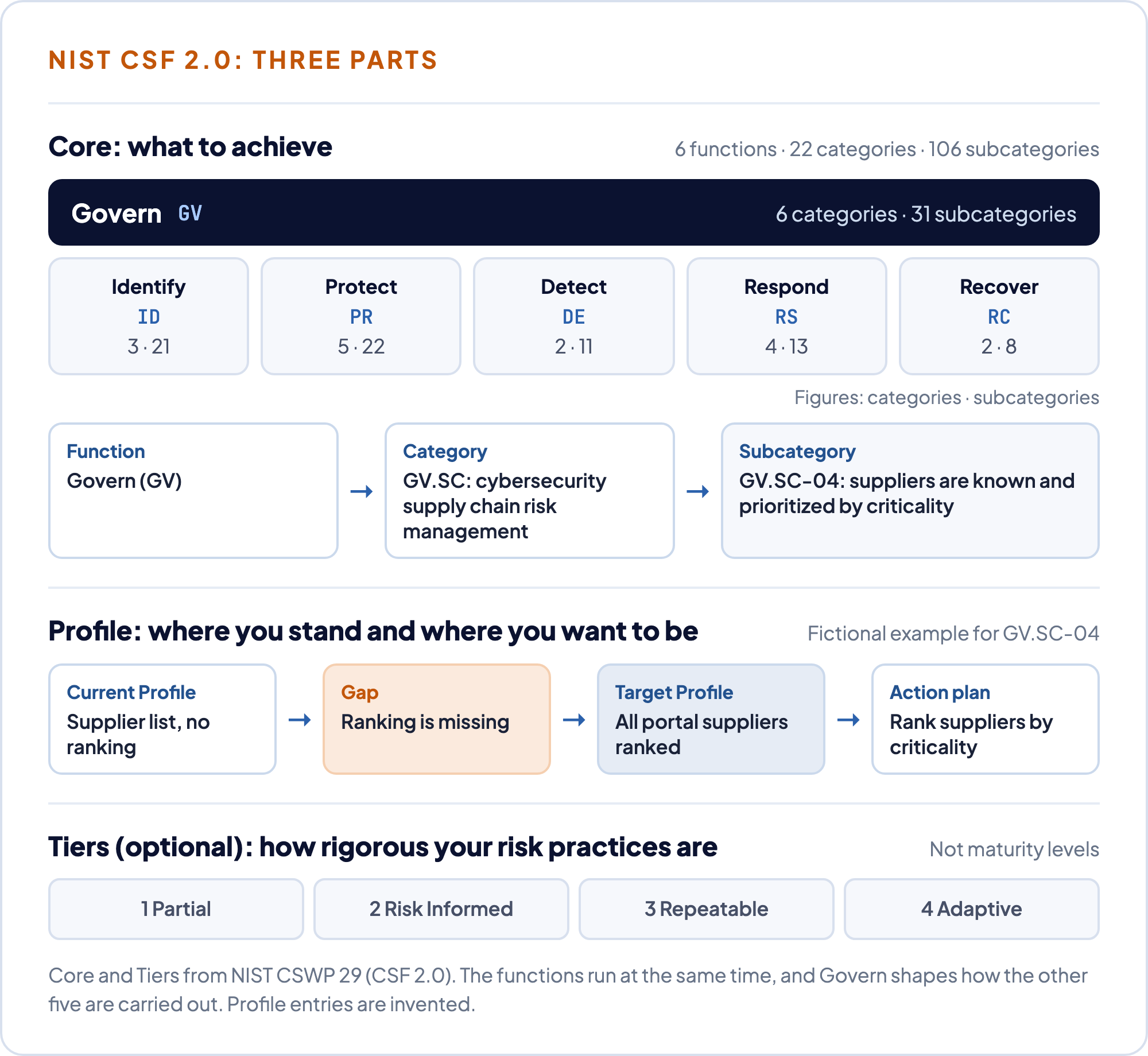
The NIST CSF framework has three parts: the Core, Organizational Profiles and Tiers. The Core arranges outcomes by function, then category, then subcategory. You work on all six functions at once, since NIST sets no order. Govern shapes how you carry out the other five.
| Function | Outcome | Categories | Subcategories |
|---|---|---|---|
| Govern (GV) | Risk strategy, expectations and policy are set, shared and monitored | Organizational context; risk management strategy; roles, responsibilities and authorities; policy; oversight; cybersecurity supply chain risk management | 31 |
| Identify (ID) | Current risks are understood | Asset management; risk assessment; improvement | 21 |
| Protect (PR) | Safeguards are used | Identity management, authentication and access control; awareness and training; data security; platform security; technology infrastructure resilience | 22 |
| Detect (DE) | Possible attacks are found and analyzed | Continuous monitoring; adverse event analysis | 11 |
| Respond (RS) | Action is taken on a detected incident | Incident management; incident analysis; incident response reporting and communication; incident mitigation | 13 |
| Recover (RC) | Affected assets and operations are restored | Incident recovery plan execution; incident recovery communication | 8 |
A Current Profile records which outcomes you achieve today and how far. A Target Profile records the outcomes you chose to reach. A Community Profile is a published baseline for a sector or use case, and it can serve as your target.
For the method, NIST adds Informative References that link outcomes to standards. It also publishes Implementation Examples and Quick-Start Guides.
How do you build a CSF profile? A filled-in example
NIST describes five steps in section 3.1 of CSF 2.0:
- Set the scope: the whole organization, or one system or threat.
- Gather policies, risk priorities and the standards you follow.
- Write the Current Profile and the Target Profile.
- Analyze the gaps and write a prioritized action plan.
- Carry out the plan and update the Profile.
Fictional example: a machine builder with 400 staff scopes its Profile to the customer portal. A US customer asked for a CSF view. All entries are invented, but the last column uses real mappings from NIST's reference tool and ENISA's table.
| Subcategory | Current Profile | Target Profile | ISO/IEC 27001 Annex A |
|---|---|---|---|
| GV.SC-04: suppliers are known and prioritized by criticality | Supplier list, no ranking | All portal suppliers ranked | A.5.19 |
| ID.AM-02: software, service and system inventories are maintained | Asset inventory last checked in 2024 | Checked each quarter | A.5.9 |
| PR.AA-03: users, services and hardware are authenticated | MFA for admins only | MFA for all portal staff | A.8.5 |
| PR.DS-11: backups are created, protected, maintained and tested | Nightly backup, restore never tested | Restore test twice a year | A.8.13 |
| RS.MA-01: the response plan runs with third parties once an incident is declared | Plan leaves out the hosting provider | Provider named in the plan | A.5.26 |
The restore test goes first. It needs no new tool, and until it runs, recovery is unproven. Supplier ranking comes next, because it decides which contracts to reopen.
The last column changes the plan if you already run an ISMS. Evidence for A.8.13 can also serve PR.DS-11, so you collect it once.
Does NIST CSF 2.0 have maturity levels?
No. NIST CSF 2.0 defines no maturity levels, only four optional Tiers.
CSF 1.1 said so outright: "Tiers do not represent maturity levels." CSF 2.0 does not repeat that sentence. It says Tiers characterize the rigor of your risk practices, in a progression from ad hoc to continuously improving. Some guides still call them a maturity rating, so check what a partner means by the word.
| Tier | What your risk practices look like |
|---|---|
| 1 Partial | Ad hoc, case by case |
| 2 Risk Informed | Approved by management, but not yet policy across the organization |
| 3 Repeatable | Formally approved, set as policy and reviewed |
| 4 Adaptive | Adjusted continuously from lessons learned and predictive indicators |
NIST encourages moving up when risks or mandates are greater, or when a cost-benefit analysis supports it. So Tier 4 is not a goal for everyone.
NIST CSF or ISO 27001: which do you need?
ISO/IEC 27001 sets requirements for an ISMS and leads to a certificate. NIST CSF sets outcomes and leads to no certificate.
| NIST CSF 2.0 | ISO/IEC 27001:2022 | |
|---|---|---|
| What it sets | Outcomes, with no prescribed actions | Requirements an ISMS must meet |
| Certificate | None from NIST, none planned | Yes, from a certification body |
| Choose it when | A customer asks for a CSF view, or management needs a shared language | A customer or tender asks for a certificate |
You can run both. Keep the ISMS as the system you audit and write a Profile on top of it.
In Rizzqo
NIST CSF in Rizzqo: systems, requirements, evidence
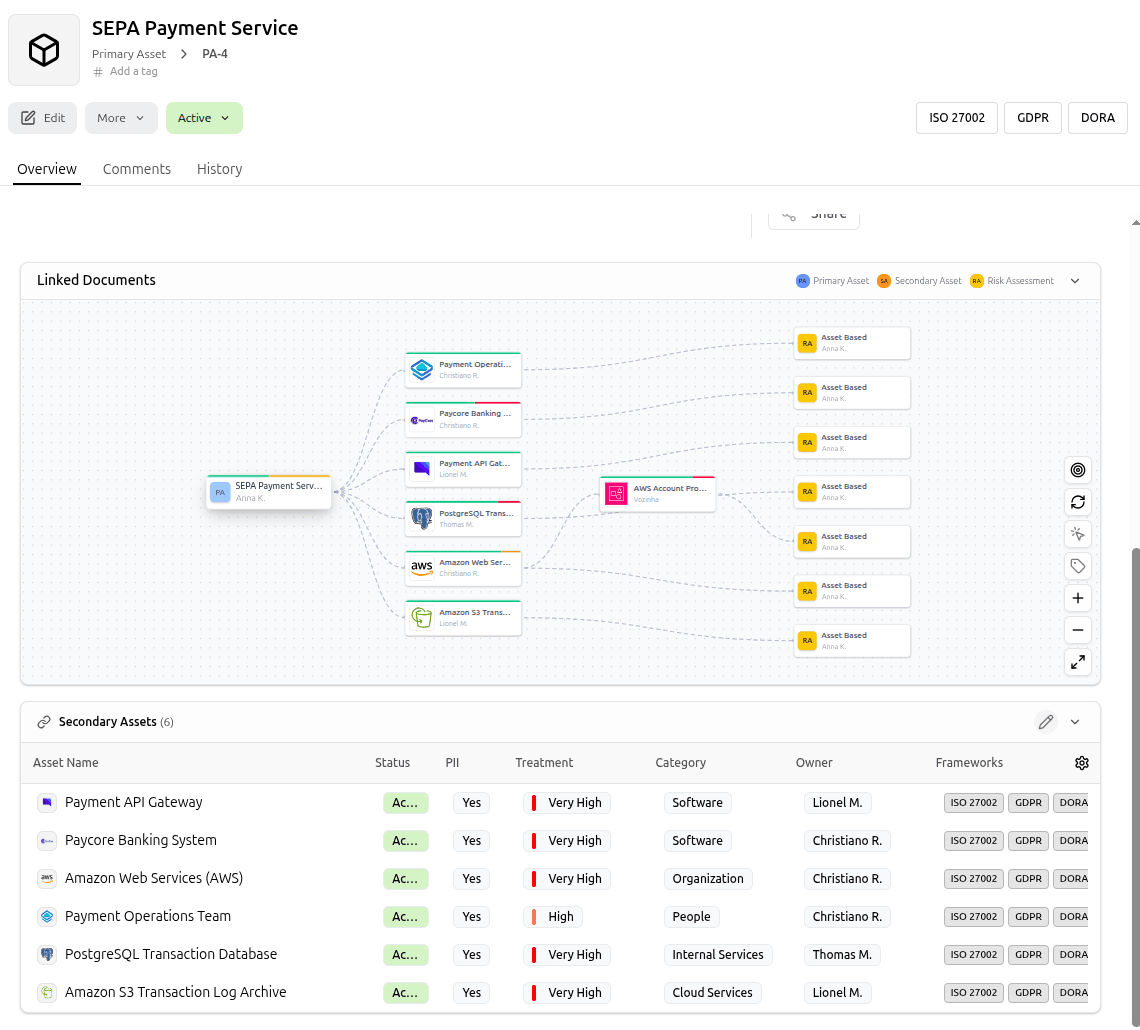
NIST CSF 2.0 is supported in Rizzqo. You record a service such as the customer portal and rate its confidentiality, integrity and availability. In asset management, you link it to the systems it depends on, such as its hosting service.
Requirements from frameworks such as ISO 27001 attach to each relevant system. The right person implements them and uploads evidence, such as a restore test report. The hosting service then shows which of its requirements are met or still open. Use that status when you write your Current Profile.
If you also work to ISO 27001, link the requirement to controls of both frameworks, and one answer and its evidence count for each.