


At a glance
- Purpose
- Cyber security as a condition for the type approval of vehicles
- How it works
- The vehicle maker gets a CSMS certificate first, then an approval for each vehicle type
- Governing law
- UN Regulation No. 155 under the 1958 Agreement. In the EU: Regulation (EU) 2019/2144, Annex II, row D4
- Who is responsible
- The vehicle manufacturer. It must also manage risks from its suppliers (paragraph 7.3.2)
- Who enforces
- The national approval authority. In Germany: the Federal Motor Transport Authority (KBA) with designated technical services
- Not to be confused with
- ISO/SAE 21434, the engineering standard; UN R156, the software update regulation
Who must comply with UNECE R155?
The vehicle manufacturer must comply with R155, because it applies for the approval (paragraph 3.1). The rules cover vehicles of categories L, M, N and O, from motorcycles to trailers. Each must have at least one electronic control unit (paragraph 1.1).
Suppliers do not apply. The maker must show how its CSMS deals with suppliers and service providers it depends on (paragraph 7.2.2.5). It collects the facts it needs through the supply chain (paragraph 5.1.1).
Which EU deadlines apply to R155 and R156?
Three EU acts set the deadlines. Regulation (EU) 2019/2144 names R155 for categories M and N in Annex II, row D4. Delegated Regulation (EU) 2025/1455 adds category L. Article 2 of Delegated Regulation (EU) 2022/2236 sets the dates for R156.
| Rule | Vehicles | New vehicle types | All new vehicles |
|---|---|---|---|
| R155 | Categories M and N | Since July 6, 2022 | Since July 7, 2024 |
| R155 | Category L, except L1e vehicles designed to pedal | From December 11, 2027 | Existing types from June 11, 2029 |
| R156 | Vehicles whose maker updates type-approved characteristics after registration | Since July 6, 2022 | Since July 7, 2024 |
| R156 | All other vehicles under Regulation (EU) 2018/858, Annex II, item H2 | Since July 7, 2024 | Since July 7, 2026. Vehicles completed in several build stages: from July 7, 2029 |
What does UNECE R155 require?
R155 asks for proof on two levels: the company and the vehicle type.
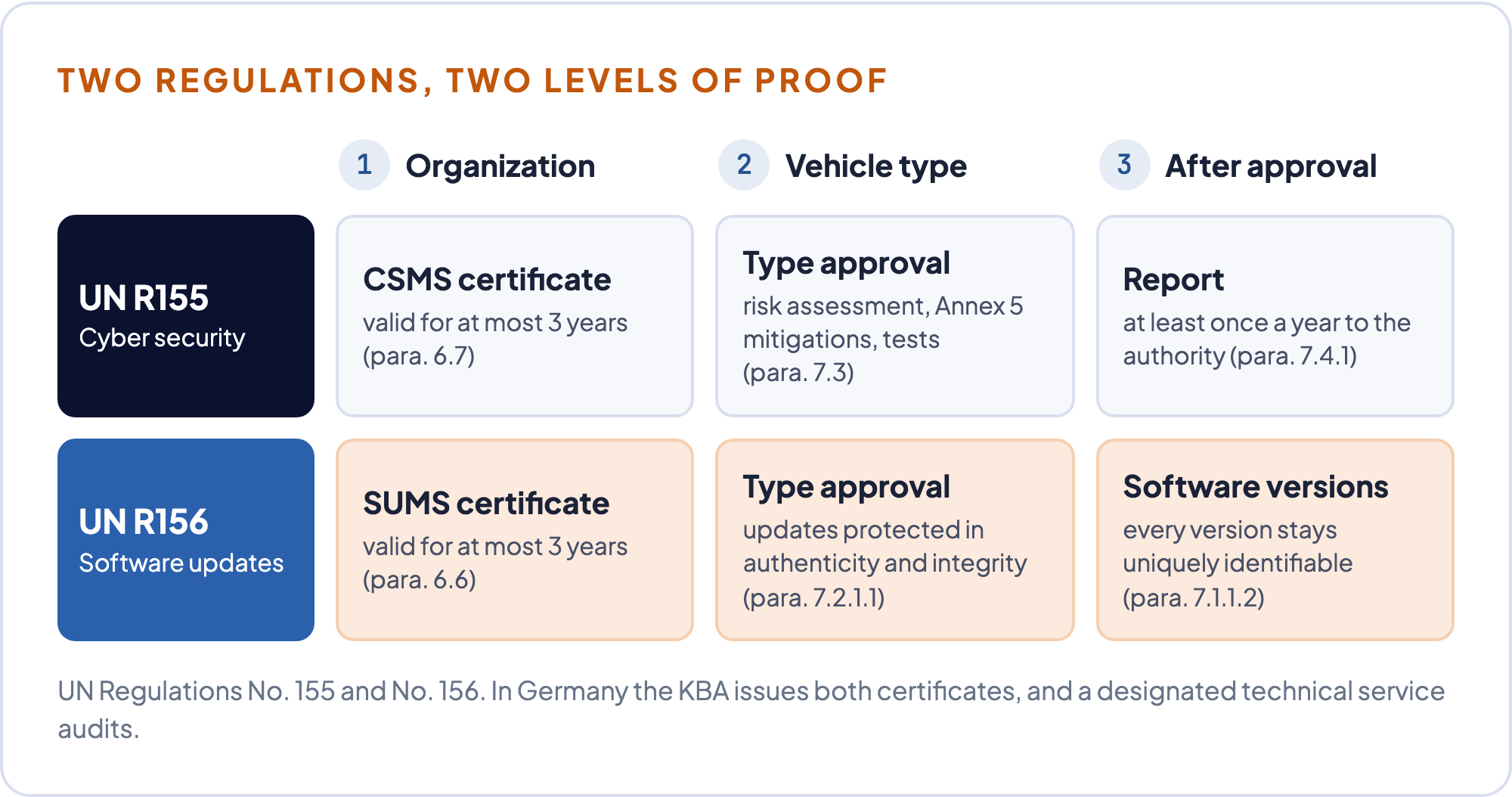
- CSMS certificate. The approval authority or its technical service checks the maker's processes. They span development, production and the time after production (paragraph 7.2.2.1). The certificate is valid for at most three years (paragraph 6.7). If it expires, the approvals built on it can be withdrawn (paragraph 6.11). In Germany, the KBA issues it based on the audit reports of a designated technical service.
- Type approval. For each vehicle type, the maker assesses the risks. It looks at all threats in Annex 5, Part A. It builds in the mitigations from Parts B and C that fit the risks. Then it tests them (paragraphs 7.3.3 to 7.3.6).
- Reporting. After approval, the maker keeps watch over its vehicles, also those on the road (paragraph 7.2.2.4). It reports the results at least once a year (paragraph 7.4.1).
What does UNECE R156 add?
UNECE R156 adds the same two levels for software updates. UN Regulation No. 156 has also been in force since January 22, 2021.
| Point | UN R155 | UN R156 |
|---|---|---|
| Subject | Cyber security | Software updates |
| Management system | CSMS, certified for at most three years (paragraph 6.7) | Software update management system (SUMS), certified for at most three years (paragraph 6.6) |
| Vehicle categories | L, M, N and O with at least one electronic control unit | M, N, O, R, S and T that permit software updates |
An RXSWIN is a number the maker defines for the software that counts for one type approval. The X is the number of the UN regulation behind that approval (R156, paragraph 2.2).
Status as of November 2026:
- R155. The original version applies with Supplement 3. All of category L has been in scope since January 10, 2025.
- R156. The 01 series of amendments has been in force since June 4, 2026. The maker now assigns a dedicated RXSWIN to each type approval whose software it updates (paragraph 7.1.1.3). Approvals to the original version, first issued before September 1, 2028, stay accepted until September 1, 2030 (paragraph 13.3).
Worked example: what a van maker asks its telematics supplier
This example is fictional. A supplier builds a telematics unit for a van maker (category N). The van maker needs five answers for its type approval:
| The van maker asks | Basis | What you hand over |
|---|---|---|
| Which threats apply to the unit? | R155, Annex 5, Part A, such as back-end servers and update procedures | Risk assessment for the unit |
| Which mitigations are built in? | R155, Annex 5, Part B and paragraph 7.3.4 | Mitigation per risk, with a reason where a listed one does not fit |
| Were they tested? | R155, paragraph 7.3.6 | Test report, dated before the approval |
| How do you report new vulnerabilities? | R155, paragraphs 7.2.2.2(g) and 7.4.1 | Contact point and reporting time in the contract |
| How are updates protected? | R156, paragraph 7.2.1.1 | Description of how each update package is signed and checked |
The result for the quote: five items go into the offer, each with a name and a date. Check every row before the van maker's audit. Is the document there? Does it name the unit's current software version?
UNECE R155 vs ISO/SAE 21434: is the standard enough?
No, the standard alone is not enough. R155 is the binding rule and sets what a maker must prove. ISO/SAE 21434 is the engineering standard for cyber security in road vehicles. A certificate against the standard does not replace the CSMS certificate. Only an approval authority issues that one (paragraph 6.1).
In Rizzqo
UNECE R155/R156 in Rizzqo: function, systems, evidence
UNECE R155/R156 is supported in Rizzqo. You record a vehicle function such as remote diagnostics. In asset management, you link it to the telematics unit and the back-end server. You add the update service obtained from your provider. Requirements from frameworks such as ISO 21434 or ISO 27001 attach to each relevant system. The right person implements them and uploads evidence, such as the test report for the telematics unit. The telematics unit then shows which of its requirements are met or still open.