


At a glance
- Purpose
- Security activities for developing and maintaining health software
- How it works
- Six clauses of requirements (4 to 9), added to an existing software life cycle such as IEC 62304
- Governing standard
- IEC 81001-5-1:2021, edition 1.0, with Interpretation Sheet 1 of December 2025; a standard, not a law
- Who is responsible
- The manufacturer of the health software
- EU and US status
- Not harmonized under the MDR or the IVDR (November 2026); recognized by the FDA
- Not to be confused with
- IEC 62304 (software life cycle); IEC 62443-4-1 (industrial products)
Who needs IEC 81001-5-1?
IEC 81001-5-1 applies to manufacturers of health software. Its introduction names four kinds:
- software in a medical device
- software in hardware intended for health use
- software as a medical device (SaMD)
- software-only products for other health use
The standard is part 5-1 of the IEC 81001 series. Its introduction says later IEC 81001-5 parts are meant for care providers such as hospitals.
Annex I, Section 17.2 of Regulation (EU) 2017/745 (MDR) requires software to be developed in line with the state of the art. It counts information security as part of risk management. Section 17.4 has the manufacturer set out minimum requirements for IT security measures.
Sections 16.2 and 16.4 of Annex I to Regulation (EU) 2017/746 (IVDR) say the same for in vitro diagnostic devices. Neither regulation names the standard.
What does IEC 81001-5-1:2021 require?
IEC 81001-5-1:2021 requires security activities in clauses 4 to 9. Clauses 5 to 8 follow the order of IEC 62304.
| Clause | Subject | Activities it names, as examples |
|---|---|---|
| 4 | General requirements | Quality management system, security expertise, third-party software items, disclosing security-related issues |
| 5 | Software development | Secure coding standards, defense-in-depth architecture, vulnerability testing, penetration testing, controls for private keys |
| 6 | Software maintenance | Timely delivery of security updates, monitoring public incident reports |
| 7 | Security risk management | Product security context, threats, risk controls and their effectiveness |
| 8 | Software configuration management | Configuration management of the software |
| 9 | Software problem resolution | Receiving, reviewing and analyzing vulnerabilities, addressing security-related issues |
The requirements derive from IEC 62443-4-1. The IEC 62443 entry explains that series.
How do you classify software items? A filled example
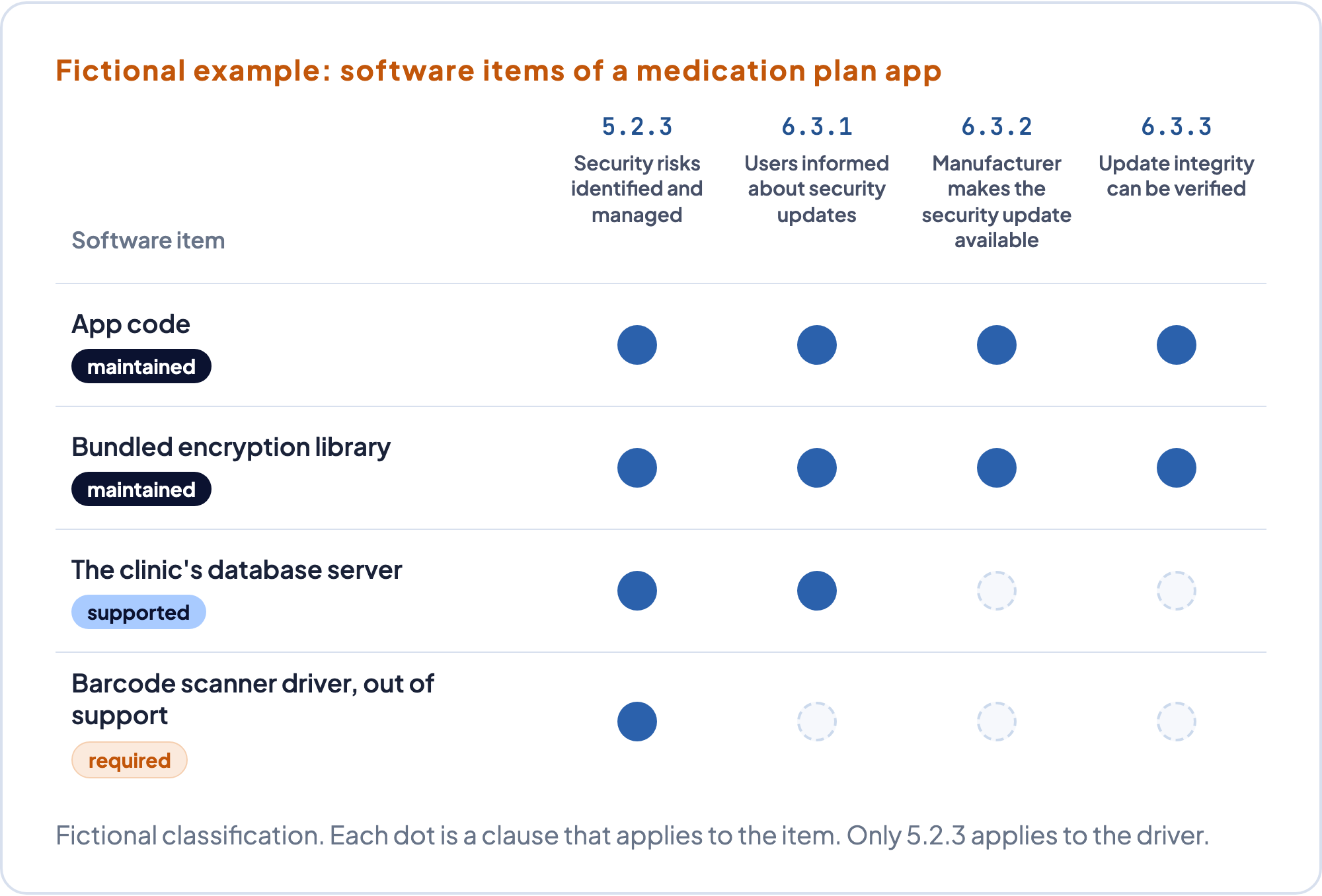
Clause 4.3 has you classify each software item in your product as maintained, supported or required software. Interpretation Sheet 1 states which clauses apply to each category.
| Category | What Interpretation Sheet 1 says | Clauses that apply |
|---|---|---|
| Maintained | The manufacturer makes the security updates available, with verifiable integrity | 5.2.3, 6.3.1, 6.3.2, 6.3.3 |
| Supported | The manufacturer does not provide the security updates. The operator controls when or whether one is installed, and the manufacturer notifies users about it | 5.2.3, 6.3.1 |
| Required | The manufacturer cannot obtain security notifications or updates, for example after end of support | 5.2.3 |
Fictional example: the maker of a medication plan app classifies four software items. The app code and a bundled encryption library are maintained. The clinic's database server is supported. A barcode scanner driver without support is required.
Use the same five steps on your own product:
- List every software item, including third-party components. An SBOM gives you that list.
- Assign each item one category.
- Apply the clauses of that category. For the driver, you identify and manage its security risks under 5.2.3.
- Tell the operator which category each item has.
- Re-evaluate the clauses when you downgrade an item, for example from maintained to required.
Keep the items in your asset inventory, each with a named owner.
IEC 81001-5-1 vs IEC 62304: what does each one cover?
IEC 62304 defines the software life cycle processes for medical device software. IEC 81001-5-1 adds the security activities to that life cycle and covers all health software.
According to its introduction, IEC 81001-5-1 looks at any use, including foreseeable unauthorized access. It therefore takes in more software than a safety view does: drivers, platforms and operating systems. Conformance with IEC 81001-5-1 is not necessarily sufficient for conformance with IEC 62443-4-1.
Is EN IEC 81001-5-1 harmonized in the EU and recognized by the FDA?
EN IEC 81001-5-1 is not harmonized under the MDR or the IVDR, as of November 2026. The lists in Implementing Decisions (EU) 2021/1182 and (EU) 2021/1195, last amended on November 9, 2026, do not contain it. Applying it therefore gives no presumption of conformity under Article 8(1) of either regulation.
The Commission's standardization request M/575 lists the standard for the MDR, with an adoption deadline of May 27, 2028. By that date, CEN and CENELEC are to adopt it. It is not a harmonization date. The request's annex for the IVDR does not list the standard.
Team-NB, the European association of notified bodies, called IEC 81001-5-1 a state of the art standard in October 2022. Its position paper recommends adoption through transition plans.
In the United States, the FDA recognizes the complete standard under number 13-122, entered on December 19, 2022. The record adds a caveat: conformance may not meet every cybersecurity requirement in section 524B of the FD&C Act. The FDA's premarket cybersecurity guidance of February 2026 names it as one framework you can use for secure product development.
In Rizzqo
IEC 81001-5-1 in Rizzqo: release, systems, evidence
IEC 81001-5-1 is supported in Rizzqo. You record a process such as the release of your medication plan app and rate its confidentiality, integrity and availability. In asset management, you link it to the code repository, the build server and the update server. Requirements from frameworks such as ISO 27001 attach to the repository and to both servers. The right person implements them and uploads evidence, such as a penetration test report, and the build server then shows which of its requirements are met or still open.