


At a glance
- Purpose
- Safety rules for machinery sold or put into service in the EU
- How it works
- The manufacturer meets Annex III, runs a conformity procedure, issues the EU declaration and affixes the CE marking
- Governing law
- Regulation (EU) 2023/1230, applies from 20 January 2027 (Article 54)
- Who is responsible
- Manufacturers first; importers, distributors and authorized representatives have their own duties (Articles 10 to 17)
- Who enforces
- National market surveillance authorities; each Member State sets the penalties (Article 50). Germany, from 20 January 2027: fines up to EUR 10,000, or up to EUR 100,000 for certain breaches (Section 9 of the German implementing act, MaschinenDG)
- Not to be confused with
- Machinery Directive 2006/42/EC; Cyber Resilience Act; Germany's 9. ProdSV, which is also titled "Maschinenverordnung"
Who does the Machinery Regulation apply to?
The Regulation applies to machinery, partly completed machinery and related products. Related products are interchangeable equipment, safety components, lifting accessories, chains, ropes, webbing and removable mechanical transmission devices (Article 2(1)).
Article 2(2) excludes, among others, weapons and motor vehicles. Machinery mounted on a motor vehicle stays in scope.
An operator can become a manufacturer. Under Article 18, whoever makes a substantial modification takes on the manufacturer's duties. Non-professional users who change a machine for their own use are exempt. Article 3(16) sets the test, and all three conditions must hold:
- The change is physical or digital, and the manufacturer did not foresee or plan it.
- It creates a new hazard or raises an existing risk.
- It needs new guards that change the safety control system, or extra steps for stability or strength.
So a software update can count if it meets all three.
When does the new Machinery Regulation apply?
The new Machinery Regulation applies from 20 January 2027, and the Directive ends that day (Articles 51 and 54). It entered into force on 19 July 2023.
A machine first made available in the EU from that day must meet the Regulation. A machine placed on the market under the Directive before then can still be sold (Article 52).
EC type-examination certificates stay valid until they expire (Article 52(2)). A machine placed on the market from 20 January 2027 must still meet the Regulation. Ask your notified body if it then needs an EU type-examination certificate.
Status as of November 2026:
- Standards. The Commission is preparing the first list under the Regulation. It expects the list before the end of the year. The Directive's list ends on 20 January 2027.
- Omnibus IV. This amending act is not yet law. Parliament and Council reached a provisional deal in June 2026. Under it, the EU declaration of conformity must be digital. That rule starts 30 months after the act enters into force. The agreed text does not move the 20 January 2027 date. Parliament's indicative vote date is 23 November 2026.
Which conformity procedure applies under the Machinery Regulation?
The procedure depends on where the machine sits in Annex I (Article 25). Part A has 6 categories, such as vehicle servicing lifts. Part B has 19, such as circular saws and logic units for safety functions.
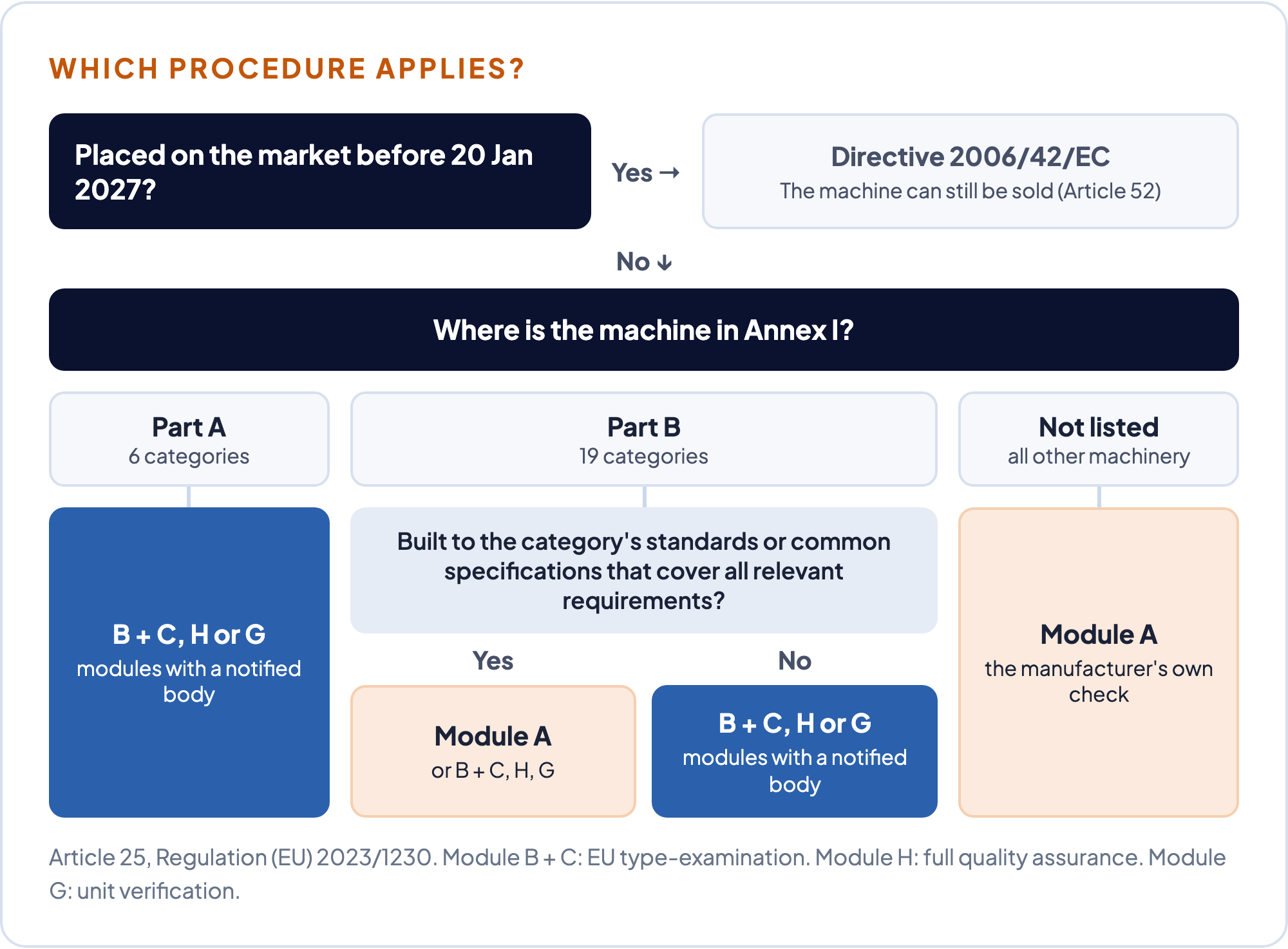
Part A requires module B + C, H or G. Part B also allows module A, on one condition. The machine must be built to the category's harmonized standards or common specifications. These must cover all relevant duties (Article 25(3)). Machines not listed use module A (Article 25(4)).
Modules B, H and G all use a notified body. Module A is the maker's own check. On every route, you keep the technical file and the declaration for at least 10 years (Article 10(3)). Partly completed machinery gets an EU declaration of incorporation instead (Articles 11 and 22).
Machinery regulation harmonized standards give a legal presumption. The standard must be cited in the Official Journal. A machine that follows it is presumed to meet the Annex III duties it covers (Article 20(1)). According to the Commission, the first list will hold the vast majority of standards cited under the Directive. Standards that do not fully cover new duties will be clarified to that extent.
Worked example: a press brake with remote maintenance
This example is fictional. A machine builder ships a hand-loaded press brake with a remote maintenance gateway in March 2027, so the Regulation applies. It checks five points:
- Annex I. Hand-loaded presses for cold metal work are in Part B, point 9. The test is travel above 6 mm and speed above 30 mm/s. This press has 200 mm travel and 150 mm/s approach speed, so it is in.
- Route. Assume the cited standard for this press has a restriction on protection against corruption. No other standard or common specification for the category fills the gap. Module A is then closed (Article 25(3)). The builder picks module B + C, H or G.
- Connection. Under Annex III, section 1.1.9, the link through the gateway must not lead to a hazard. Safety-critical software and data are identified and protected.
- Control system. Under section 1.2.1, it withstands foreseeable malicious attempts that lead to a hazard. This holds where the risks call for it. A log of interventions and safety software versions stays on for five years after each upload.
- Test. Update the safety software through the gateway. The press should name the new version and record the change.
The result for planning: the notified body goes into the project plan, and the gateway gets its own test report. If the standard covers all relevant duties, module A stays open.
Machinery Regulation vs Machinery Directive: what changes?
The Machinery Regulation replaces a directive with a law that applies directly in every Member State.
| Point | Directive 2006/42/EC | Regulation (EU) 2023/1230 |
|---|---|---|
| Legal form | Transposed nationally; in Germany by the 9. ProdSV, which ends on 19 January 2027 | Directly applicable |
| Strictest list | Annex IV: harmonized standards open the maker's own check | Annex I Part A: a notified body every time |
| Later changes | No definition of substantial modification | Defined, physical or digital (Article 3(16)) |
| Software and connections | No section on corruption | Annex III, sections 1.1.9 and 1.2.1 |
The Regulation is also not the Cyber Resilience Act. The Regulation looks at cyber risks that can hurt people. The CRA sets security duties for products with digital elements, mainly from 11 December 2027. A machine that is also such a product must meet both. According to recital 53 of the CRA, meeting the CRA could ease sections 1.1.9 and 1.2.1. The maker must show this.
In Rizzqo
The Machinery Regulation in Rizzqo: systems, requirements, evidence
The EU Machinery Regulation is supported in Rizzqo. In asset management, you record the systems behind a press brake. Examples are its control software, remote maintenance gateway and update server. Requirements from frameworks such as the CRA attach to each relevant system. The right person implements them and uploads evidence, such as the report of your gateway test. The gateway then shows which of its requirements are met or still open.