

At a glance
- Purpose
- A minimum level of information security for Swiss railways as part of the country's critical infrastructures
- How it works
- 7 ISMS requirements (A-01 to A-07) and 29 baseline controls (B-01 to B-29), applied by risk
- Governing law
- Article 2(1bis) EBV (SR 742.141.1) and AB 2.1bis of its implementing provisions (AB-EBV), both in force since July 1, 2024
- Who is responsible
- Infrastructure managers and railway undertakings. They stay responsible when suppliers do the work
- Who enforces
- The BAV. The directive is a basis for the checks in its supervision
- Not to be confused with
- CLC/TS 50701 and IEC 62443, which are technical standards; an ISO/IEC 27001 certificate
Who must apply RL CySec-Rail?
RL CySec-Rail applies to two groups of railway companies in Switzerland (chapter 5):
- Infrastructure managers (ISB) that hold a concession and a safety authorization under Article 5 of the Railways Act (EBG).
- Railway undertakings (EVU) that hold a safety certificate under Article 8c EBG.
The directive covers their systems and data networks in three areas. These are IT, the operational technology (OT) of fixed installations and rail vehicles. If a company hands tasks to suppliers, manufacturers or maintenance firms, the rules apply there too. The company stays responsible.
Under Article 2(1bis) EBV, railway structures, installations and vehicles must be protected against threats, attacks and misuse. The company must use all proportionate means for this. AB 2.1bis of the AB-EBV then requires an ISMS. For the minimum requirements it points to the directive.
The BAV publishes the text in German (the original), French and Italian. English terms on this page are our translation.
Under chapter 5, a company with no or a negligible attack surface can ask the BAV for an exemption. Heritage railways are the directive's example. The request must be renewed every five years (annex 4).
What does RL CySec-Rail require?
RL CySec-Rail requires an ISMS that meets seven requirements, plus 29 baseline controls. The company picks and ranks the controls by risk.
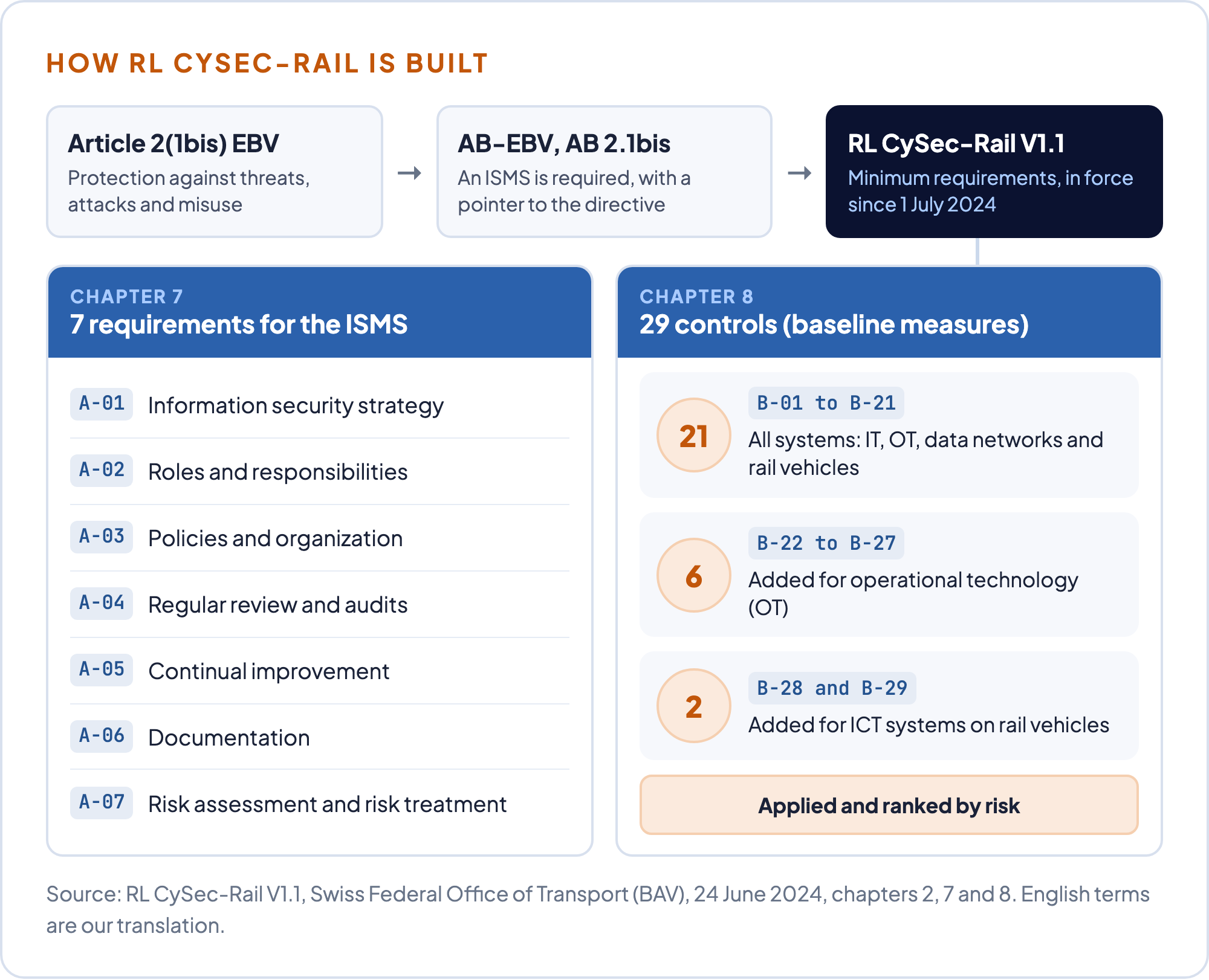
Chapter 7 holds the seven requirements: strategy, roles, policies and organization, audits, continual improvement, documentation and risk treatment. They include:
- A-01: Top management sets the security goals and provides the resources.
- A-02: The company names an information security officer and tells the BAV who it is.
- A-04: It runs audits on an audit program, and these cover suppliers.
- A-05: It checks the suitability and effectiveness of the ISMS at least once a year.
- A-07: It repeats the risk assessment at least once a year.
- For all seven: it keeps a binding timetable for the work and shows it to the BAV on request.
Chapter 8 holds the controls. B-01 to B-21 apply to all systems, from access management to vulnerability management. B-22 to B-27 add rules for OT security. B-28 and B-29 add rules for systems on rail vehicles. Under chapter 8.2, the company must prove that a security measure in OT does not impair safety functions.
The directive allows deviations if the company reaches the aim of the law and the ordinance another way. It records compensating measures in writing.
Worked example: a software update on an OT system
This example is fictional. A regional railway plans a software update for its train control system. Control B-22 sets seven points, and the railway keeps one record for each:
- Staff. Qualified staff install the update. Record: name and qualification.
- Vendor window. The vendor delivers updates within a period agreed in advance. Record: the contract clause.
- Approval. The update passes an approval process that involves safety management. Record: the signed approval.
- Test. The software is tested before installation. If problems show, the update stops. Record: the test protocol.
- Rollback. A rollback strategy is defined and tested in advance. Record: the rollback test.
- Log. The log shows who installed the update and why.
- Archive. The older version is archived with its parameters.
The result for the next audit: seven records per update, filed with the system. A significantly changed installation also needs an operating permit under Article 8 EBV. In case of doubt, the directive says to contact the BAV.
RL CySec-Rail vs CLC/TS 50701: what is the difference?
RL CySec-Rail sets what a railway's management system must achieve. CENELEC TS 50701 describes how to secure a railway system.
| Point | RL CySec-Rail | CLC/TS 50701 |
|---|---|---|
| Issuer | BAV, a Swiss federal authority | CENELEC, a European standards body |
| Type | Directive based on the EBV | Technical Specification, 2023 edition |
| Subject | The company's ISMS and baseline controls | Cybersecurity of railway systems across their life cycle |
| Built on | ISO/IEC 27001 and 27002, NIST CSF 2.0 | The IEC 62443 series |
The directive lists the specification among its references. Single controls point to it for detail. B-26 on network segmentation cites SR 5.1, and B-22 cites chapters 9, 10.2 and 10.3. The directive also explains the family tree. IEC 62443 builds on the ISO 27000 standards and adds industrial automation. The specification builds on IEC 62443 and adds railway systems and rail vehicles.
As of November 2026, IEC 63452, an international standard on cybersecurity for railway applications, is out for vote as a final draft. Version 1.1 of the directive cites CLC/TS 50701:2023.
In Rizzqo
RL CySec-Rail in Rizzqo: process, systems, evidence
RL CySec-Rail is supported in Rizzqo. You record a process such as train control and rate its confidentiality, integrity and availability. In asset management, you link it to the train control system, the data network and the service obtained from your maintenance firm. Requirements from RL CySec-Rail attach to each relevant system, and the right person implements them and uploads evidence, such as the test protocol of a software update. The train control system then shows which of its requirements are met or still open.